Gender inequality: Treating the root causes

FB_IMG_1541077353006

A couple in a community in Arua District, West Nile region, Uganda (photo by: Aidah Bukubuza)

She sipped her tea and focused her eyes on me, like I had mentioned something outrageous. With a gentle grip on my right hand, my mom started narrating how intolerable things were, in her time. “In my days, women had no say”, she said with a deep stare in my eyes.

My mom turns 67 in exactly 8 weeks, and she still thinks that our culture and societal norms are frustrating the full potential of women and girls. In her youth, girls were married off without their consent, to men they did not know, choose or love. Bride prices were negotiated at local drinking parlours where only men wined and dined. And there, they made decisions concerning matters as trivial as bed time.  Women and girls never ate what was considered delicious like chicken, they never sat on chairs or uttered a word in gatherings, let alone sit anywhere close to where their male counterparts sat “at the table of men”.

                “women don’t speak when men are speaking”

With much disgust she expressed how brilliant and intelligent women and girls were reduced to mere property, baby making machines and slaves.  She wondered how many books would have been written by now, “who knows, some would have figured out some of our country’s greatest puzzles like managing waste for instance”, she chuckled.  Wife beating was okayed and justified, women had no say over their own bodies and many other unspeakable things, they were owned!

“As a man you need to beat your wife” – Remarks made by a member of Parliament in Uganda

As ghastly as it sounds, these traits were, and some are still embedded in our highly treasured culture and societal norms. In my village and various other communities, nothing seemed to have changed. My mom recounted a story of a 13-year-old girl whose father continuously paraded before his male guests, so he could marry her off and receive benefits inform of dowry. Education for this young girl was never a priority to her father, her age, dreams, future and aspirations never mattered.

A loud silence filled the living room, with mom still holding on tight to my hand and her cup of tea. My mind travelled through all the communities I knew, visited all the young girls I had ever met, wondering what I could do to protect them, give them hope, change the business as usual. Everything around us seemed dark and dead in that moment, with a feeling of hopelessness and grieve for the many dreams that had been murdered by the gender inequalities and marginalisation.

She sipped her tea again and stared deeply in my eyes, this time it seemed like she was about to give me an assignment.

if your daughters are to live a better life, in world free from all this unfairness, judgement, objectification, disrespect and disregard for life, rights and values, then the culture and beliefs have to change. Re-write the norms!”. She said.

Her words felt like a siren, resounding in my ears and mind. I had been handed the mantle from the generation before, a responsibility and a charge to do greater than my mom and her generation ever could do to end violence against women and girls and achieve gender equality and equity.

Our cultures are valuable, they are a beautiful part of who we are, but, some pillars in this unwritten constitution are the very cause of the gender and some sexual reproductive health and rights issues we are battling in our communities today. The various forms of violence against women and girls, the gender inequity and inequality, teenage pregnancies among others,  are induced and reinforced by our culture and societal norms.

Addressing these symptoms and achieving the global agenda  for gender equality necessitates a multilevel, sectoral and holistic approach, of which redefining the wheels on which our communities ride is key. We need to involve our communities, leaders and custodians of tradition in efforts to achieve a world free of violence against women and girls, enforce policy and support transitions from the old to the new age of gender equality and equity.

Educate us | listen to us | we are partners not subordinates | we are humans too with dreams and hopes | our efforts and ideas are equally valuable | involve us”


Photo credit: Aidah Bukubuza

Sustaining Civil Society: Rethinking resource mobilisation

RM pic

“While businesses thrive on profits, and governments on taxes, civil societies finance their activities through donations and grants’’ (noted Yancey and Siegel)

These observations by Yancey and Siegel couldn’t be more accurate! In Uganda and in various parts of the world, CSO’s scramble for the little resources available through grant aid, public and private funding. While some are still employing conventional means to secure finances for the various activities they implement, most CSO’s have devised new strategies for generating and securing resources, such as; forming networks, organising public events, to mention but a few.

Amidst these challenges, CSO’s have resorted to synergistically soliciting funds from the various channels. For instance, on the 27th of February 2018, Uganda Youth and Adolescent Health Forum (UYAHF) in collaboration with Girls Not Brides (GNB), hosted a call for proposal debrief at the UYAHF offices in Kampala with an aim of sharing proposal writing skills, grant application and winning tips.

Kios pic

The debrief was graced by representatives from five different organizations including; Raising Teenagers, Joy for Children Uganda (JFCU), Education and Development Opportunity Uganda (EDOU), Uganda Youth and Adolescent Health Forum (UYAHF) and Vision for Children Initiative (VCI).

‘’We can no longer take these steps by ourselves. We have created a synergistic community. We must take a step towards knowledge together.” (Alberto Villoldo)

In the session led by Moses Ntenga from JFCU and GNB networks, participants learnt about the various funding opportunities available, and key things to focus on when writing project proposals. He noted the need to identify funders interest’s vs CSO project needs, including required documents and testimonials to make proposals stronger and utilizing the existing network of CSO’s in application processes and reviews.

Moses‘’Understanding the key interest of the funder, projects of interest, assessment criteria, the amount of funding being offered and drawing a realistic budget is key. It is important to write proposals centred around cases with correct statistics and as well as the beneficiaries’’ (Moses Ntenga)
 

From the three hours long debrief, it was evident that CSO’s were interested in thriving as a team, rather than competing and fighting over the available resources without proper strategies. Representatives appreciated GNB’s and UYAHF’s efforts channelled towards achieving common goals, which are the success of individual CSO’s and achieving national and global goals.

While ensuring the long life of CSOs remains a challenge in development, harnessing the benefits of synergy with strategy among CSOs and networks might just be the long sought for solution.

Author: Precious Mutoru

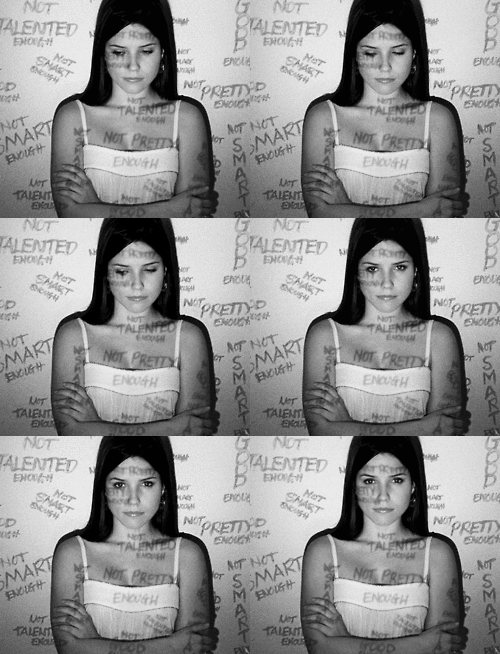
Not pretty enough..

giphy

My alarm went off at 08:30 hours in the morning, it was time to go! Clad in a black pair of linen pants and an off-white chiffon blouse, I majestically took my first step to what would be my very first student job interview and hopefully job placement.  Beyond the culture and trends in Europe, working while pursuing education in higher institutions of learning or during school breaks is a must do. Even so, home office considers side hustles, I mean, why would they grant foreign students 20 hours of work every week during school term and freedom to work full time during school break?

The fresh spring breeze brushed gently over my face, as I paced through the walk ways to the bus station. My mind filled with thoughts of what savings from this job could do for me. The bus pulled up just in time for me to get in first. I quickly handed the bus driver four pounds (4£) for a day ticket and took the first seat right behind the driver’s cabin. I could hear my own heart beat like the African Ngoma drum.

Six bus stops later, it was my turn to alight. With my phone in hand, I stepped out and followed the GPS coordinates to the interview venue. The room was filled with young people and like you would guess, they were preoccupied with their phones and some, chatting with those they knew. I took a seat in a far-off corner and silently recited answers to what I hoped would be some of the interview questions.

A gentleman stood in the hallway and called out my name. From the accent, I could tell that he was a brother from the western part of Africa. I picked up my bag and walked down the hallway to the interview room, it was my turn to shine. Like the smart and intelligent woman that I am, I confidently answered the questions I was asked. The panellists seemed impressed with what they heard and soon wrapped up the interview with “thank you for coming through, we shall be in touch”. With a bright smile, I walked out of the interview celebrating my latest achievement, a student job placement.

I stood in the hallway behind the half way shut door, impatiently searching through my bag for my phone, an update was in order. I could clearly hear the voices in the interview room arguing over scores. My curiosity overshadowed my mother’s long-standing principle taught to us “thou shalt not eavesdrop”. I stood still and listened to these masculine voices commend my smart brain. The conversation continued with reasons why I deserved a spot, and, on several occasions, I caught myself nodding to some of the points these gentlemen noted.

While I was still lost in the possibilities that were soon becoming my reality, I heard one comment that brutally shook me back to my senses. “.. she is smart and pretty, but not pretty enough, besides she is a little too curvy”, one gentleman said.  I saw the opportunity that had kept me excited for days slip through my hands, as this gentleman continued to talk about my body. Despite my knowledge, excellent skills, eloquence and confidence exhibited, my qualification for this job had just been reduced to my looks, my body and my skin complexion.

A million questions ran through my mind as I walked back to the bus station. I wondered whether the male interviewees were scrutinised in the same way I was, or perhaps, this was a criterion for the females. I thought about thousands of women all over the world who have and continue to face similar challenges at places of work, school or positions of leadership.

Even with such bold gender achievements, women are still less likely to compete fairly and have access to opportunities as our male counterparts. We are labelled and our strengths and abilities placed on weighing scales from the very day we are born. She can’t out smart you, she is a girl, she won’t make a good wife because she doesn’t know how to cook, she is such a horrible mother for choosing work over children, she cannot be a leader because she is not married, to mention but a few.

Our struggle to have our fair share in a world where women out number men is far from over. For long, our efforts have been misconceived, with many viewing women as angry and selfish opponents to men. It’s no surprise that we haven’t realised our vision of full equality.  We all have the power and responsibility to end discrimination of all forms against women and girls, and promote gender parity around the globe, irrespective of of who we are.

I find consolation in the quick wins each time I stumble and continue to strive for freedom, equality and quality dignified lives for the cornerstones of our nations, women!

Author: Precious Mutoru

SHE Decides – Without Question!

IMG_8732


Sad tales of women and girls, both heard and unheard, continue to trigger anger, questions, but most of all fuel action to end the pain that they have suffered and restore their long-lost dignity. It goes without question that for a long-time, women’s and girls’ rights have been brutally violated in unthinkable ways, in various parts of the world.

For instance, the Uganda District Health Survey (DHS) report released in 2016 indicates that 1 in 5 women aged 15 – 49 report an experience of sexual violence at least once from the time they turn 15 years of age. The report further points out that, there has been a slight increase in teenage pregnancy from 24% in 2011 to 25% in 2016. Approximately 28% of married women and 32% of unmarried women still have unmet need for family planning. These and other challenges such as HIV/ AIDS prevalence and unfriendly SRH policy environment continue to significantly affect women and girls in Uganda

The voices of young girls and women narrating their experiences continue to awaken us to the reality that these are more than just statistics, these are our mothers, wives, sisters and daughters summarized in numbers.

PhotoGrid_1520407881157When I turned 14 years old, a boy who  supported me financialy  since my parents were poor, impregnated me. Shortly after giving birth, he abandoned my baby and I with nothing to survive on”.   (young mother)

The father of my child commanded me to get rid of the fetus, but I refused to do so in fear of what could possibly happen to me’’.  (young mother) 

In response to these unacceptable statistics and status quo, interventions, campaigns and movements have been created and implemented. A case in point is the recently commemorated She Decides movement. Launched at the start of 2017 as an urgent reaction to the reintroduction and dramatic expansion of the Global Gag Rule, She Decides has rapidly evolved from two words, to a one day pledging conference into a global, political movement with community support. In the first year of the movement, over 40,000 individuals and 150 organisations have signed up as friends. Friends agree to take action guided by the vision  articulated in the She Decides Manifesto: A new normal where girls and women decide about their bodies, their lives, their futures. Without question.

She Decides has become an urgent rallying cry leading to the formation of a global movement, now generating national and regional movements to mobilise all those who define themselves as Friends of She Decides to maintain the momentum. The uniqueness of the movement lies in its clear vision, strong political leadership, and its bold approach and its transformative, agile working model. She Decides breaks down traditional silos, builds on the work of others and brings in the energy of many new voices.

On 2nd March 2018, the  Uganda Youth and Adolescent Health Forum  (UYAHF), who are also global champions of She Decides movement in Uganda joined the rest of the world in standing up, speaking out and taking action for women and girls all over the world. UYAHF hosted a hangout at our offices in Kampala with an aim of popularising the movement and bringing on board all key stakeholders, both directly or indirectly involved in championing girls’ and women’s rights. Over 150 people were a part of the event, with guests from UNFPA, 10th parliament, Mulago hospital, National Population Council, Center for Human Rights and development (CEHURD), various CSO’s and networks. Also, representatives from Belgium, Swedish, Danish and Dutch embassies in Uganda as well as young people were in attendance.

During the panel discussion, one of the panellists attested to the plight of pregnant teens and young mothers. In his remarks, Dr. Kiggundu Charles, a passionate obstetrician  and gynaecologist from Mulago Hospital in Kampala, said;

IMG_20180307_101914I attend to at least four girls who have been sexually abused  every week. They come to seek help and support. Some seek abortion while others choose to carry their pregnancies to term. Often times, these young mothers deliver unhealthy babies, who eventually die before their first birth day. Also, the girls don’t have correct SRHR information which has resulted into uninformed decisions’’ (Dr. Kiggundu Charles)

An analysis of the state of women and girls, backed by testimonies of young mothers and an experienced obstetrician / gynaecologist triggered questions, discussion of strategies and recommitments, as well as new pledges. Joy Asasira, a human rights activist noted that, the Ugandan government has made various commitments, thus the urgent need to hold our government accountable and demand for results. This critical observation was reiterated by the woman member of parliament for Ntungamo district, Hon. Beatrice Rwakimani, who also sits on the parliamentary health committee. In her remarks, she stressed that;

“..the high level political engagements ought to put the rights and health needs of girls and women first, if they are to dent the ever increasing SRH related statistics in relation to teenage pregnancies, school drop outs, child marriages and unsafe abortions. The  well-being of women and girls in Uganda need to be prioritised and I pledge to advocate for an increase in the next financial year’s budget allocations in line with one of the She Decides agenda’’. (Hon. Beatrice Rwakimani)

More pledges were made by the UNFPA deputy country representative, Miranda Tabifor and the deputy head of missions for Belgium Embassy, Mr. Erwin De Wandel, who promised to continue supporting initiatives that seek to promote the health and well-being young people, through education, empowering girls and women, and advocating for suitable SRH policies, which directly feed into the She Decides agenda.

The urgent need to demand accountability from governments, stakeholders, support from community and bridge the gap between the status quo and what is envisioned for girls and women in Uganda is prominent. With movements like She Decides, that strongly believe that when a girl or woman decide, the world is better, Stronger and safer, as they are the cornerstone of communities, enthroning the She’’ is achievable.

The Uganda She DecidesHang Out” happened just after the She Decides Day 2018 flagship event in Pretoria and She Decides global champions meeting, that saw She Decides friends and champions from over 50 countries take action to promote the vision of the manifesto and vigorously action across three pillars of work namely; Stand Up, Speak Out, Change the rules and Unlock resources.

This slideshow requires JavaScript.

Authors: Precious Mutoru and Patrick Mwesigye

Why is my body changing?

IMG_7904

According to Uganda National Household Survey 2016/2017, 34.8% of Uganda’s 34.6 million populations are adolescents, 78% of these are attending school and 22% have left school. On health front, already 22% of adolescents have ever had sexual intercourse and 10% of the adolescents have had sexual intercourse before the age of 15 years, one in four teenage girls in Uganda are 15-19 have had a child or are pregnant, 66% of all the new HIV infections are concentrated among adolescent girls and 40% of women age 20-24 married by age 18.

These are representations of some of the issues that greatly affect young people in Uganda. Considering this reality, Uganda Youth and Adolescent Health Forum (UYAHF) embarked on a new campaign dabbed “the school health tour’’ with a theme “healthy schools to better lives”. The purpose of the campaign is to empower school going children with health information. Among the various topics discussed are; menstrual hygiene management, personal hygiene, puberty, prevention of HIV/AIDS and other STIs, prevention of child marriages, teenage pregnancies, and gender equality.

So far, three schools have been reached and these include St. Joseph Primary School-Nansana, St. Catherine Primary School-Bukoto and Sir. Apollo Kaggwa, on 21st, 23rd February and 1st March respectively. The campaign has impacted over 550 pupils in total and aims to reach approximately 4,000 pupils and students by the end of 2018.

In an interactive manner, the facilitators share information and gather insights from pupils regarding the various health topics mentioned above, through definitions, illustrations, IEC materials, and question and answer sessions. Practical sessions are also held particularly on menstrual hygiene management.

Interestingly, pupils have great insights and are to some extent informed about the topics discussed. They have an idea of how HIV/ AIDS is transmitted, risky behaviours, effects of teenage pregnancy and child marriage among others. However, further interactions reveal the various myths and misconceptions underneath the information they have. In one of the outreaches, some pupils mentioned that they can identify a person living with HIV/ AIDS through certain body features such as; red lips, excessive loss of weight or symptoms like vomiting and fever. Similarly, pupils have incorrect information and lots of questions regarding menstrual health and pregnancy.

“Why do girls even go into menstruation period in the first place?”

“What about us boys, what’s wrong with us. Why can’t we menstruate?”

“Why should boys support girls during menstruation?”

The main objective of the menstrual hygiene management is therefore to focus on (a) the impact of menstrual management on girls in school; (b) the analysis of the role of schools in menstrual management; and (c) on possible ways forward on how to bring boys to supporting girls during menstruation. The boys showed full support and pledged to give support to the girls during this time of the month. The girls are advised to be proud of menstruation as it is a sign of maturity not a disease but should be managed well.

This slideshow requires JavaScript.

Further engagements are needed in schools to reduce on health risks in adolescents. Schools can play a role of providing safe space for pupils to express themselves and also acquire relevant information. On this note, a token of appreciation goes to Sir. Apollo Kaggwa Primary School, St. Catherine and St. Josephine Primary School for the good hospitality. The schools visited pledged full support in creating adolescent friendly environment for the learners and requested UYAHF team to make constant visits to foster sustainability of the information shared.

Authors: Allan Malcolm, Sebugwaawo Hassan and Precious Mutoru


In the Shoes of a Rural Mother: The Ideal vs. Reality

Living and working in a rural community during my time as a Global Health Corps fellow opened my eyes to harsh realities that I would have otherwise flipped past in a newspaper without thinking deeply about. I started my health information technology journey unaware of how exactly I would fit into the maternal health realm. Some of my “blank” moments included deciphering unusual statistics like “438 deaths per 100,000 live births” or complex technical jargon in this field.

As a program operations specialist, I spearheaded maternal health education in rural eastern Uganda with my co-fellow. This involved getting immersed in the community, mentoring mothers, children, and men, and working with village health team workers, health centres and stakeholders in different capacities. Every aspect of my work exposed me to the complexities in the health care system and the enormous challenges that my fellow Ugandan people have to deal with every day.

In the course of my work I met Joyce, a 28 year old mother of two who narrated that she had no idea when she first became pregnant because she was using injector plan, a popular family planning method in Jinja District. She started noticing fetal movement, dizziness, and fatigue, so she decided to go to the health centre where she discovered she was six months pregnant. However, Joyce never returned to the health centre for antenatal care because she didn’t feel the need to do so. Besides, her neighbour Zahara, a 30 year old mother of three who had recently lost her baby during delivery, told her that the nurse midwife at the centre refused to attend to her on time because she didn’t have a plastic sheet and a pair of gloves, let alone money to buy any of the required items. Afraid of going through a similar ordeal, Joyce decided to deliver with a Traditional Birth Attendant (TBA) near her home because like her neighbour, she didn’t have money or the required items. She had a painful delivery and tragically lost the baby during the process.

The hope and dream for maternal and child health care for women in the world is rosy, with teachings and emphasis on couples planning ahead of time to get pregnant then visiting the health facility to get advice and start taking prenatal vitamins like iron and folic acid to prepare the mother’s body for a baby. Then the couple gets pregnant and attends all the antenatal care visits and all services are given to them with benefits like mama kits, mosquito nets, educational sessions, and pregnant couple support. The mother eats well and follows through with all best health practices for pregnant women, including delivering in a health facility. Qualified health workers attend to her every step of the way until the baby comes, regardless of whether or not she has money and other resources. This or something close might be happening in some places, especially in urban centres, but what about that mother living in a rural area, where the best she has is access to a health centre that can barely provide pain killers to patients? This is the woman who represents the majority of Ugandan mothers!

The reality for many woman is not far from Joyce’s story. Many mothers get pregnant without planning or intending to do so. By the time they access health facilities, it’s late in the pregnancy, so the mother and baby miss out on supplementary nutrients that the body needs for healthy development. Some mothers attend antenatal care visits but most do not know that it is important for them to go. Others are afraid of accessing the health facilities because they lack of money for transport or other required items or may fear getting tested for HIV/AIDS or being turned away if they do not go with their husbands who, in most cases, are unavailable. Like Joyce, they don’t find out how the baby is faring or learn how best to take care of themselves in order to give birth to healthy babies. While focusing on the mother’s role, let’s not forget the importance of having the husband totally involved. In many cases, the men are completely absent and the mothers have to carry the entire responsibility of taking care of themselves and their families.

The thorn crown lies in the choice of where to deliver. Like Joyce, most mothers are afraid of accessing the health facility because they are afraid of being turned away or neglected by midwives the same way Zahara was, as they do not have money for items like gloves, plastic sheets or razor blades (which cost about .03 USD). The mothers then decide to visit TBAs who will warmly welcome them, take very good care of them, provide doula services, give them food and help them deliver at no cost at all and without asking for any of the items they ought to. Even though they risk losing their children, contracting diseases and infections, they would rather bow to the tradition of delivering at home with a TBA than deal with the wrath of an angry midwife in a health facility.

I realize that I do not need a medical degree to set off a wave of change in the lives of mothers and their children. With collaboration, it is possible to keep the wave moving so that tragic stories like Joyce’s can be transformed into tales of victory for mothers all over the world.

Every morning during my fellowship, I walked through the dusty, or sometimes heavily mud-covered road to work with my co-fellow, thinking about the 16 women who would not set eyes on the next beautiful Ugandan sunrise because of maternal complications that cost their lives. I thought (and still think) about their babies who would not live to celebrate their first month of life, wondering whose fault it is and whether opening the minds of mothers and fathers with education so they can make informed choices is good enough.

The dilemma that mothers like Joyce face each time they make choices surrounding birth sits heavy on my shoulders. The number 16 resounds in my mind as a reminder that safe motherhood is not the reality for many women. I realise that I do not need a medical degree to set off a wave of change in the lives of mothers and their children. With collaboration, it is possible to keep the wave moving so that tragic stories like Joyce’s can be transformed into tales of victory for mothers all over the world.

she is a woman!

I will tell you what she is not; she is not a mere exchange for bride price or a baby factory. She does not belong in a cage where she can’t discover and exploit her full potential. No! She is not voiceless; she is a roaring volcano that erupts with knowledge each time the rock she is made of shakes. She is not anything you want her to be. Instead, she is a fountain of wealth and wisdom, a visionary full of life and dreams. A strong, smart and beautiful being with power to create, change and most of all- give life and hope. With her tender heart, she gracefully takes criticism meant to break her and turns it into learning. She is a pillar of dignity and a monument of love. All she needs is a window through this nest built by the society so she can fly high. I believe in her, in her thoughts and desires and her place at the table of wisdom. I pledge to empower the girl child to overcome the odds and realize her full potential, to mentor and shape the brave everyday leader so her ambitions can come to life. I pledge for Parity!DSCN0004

Here we go!

Creating solutions to the world’s challenges is not a one man’s or woman’s call. This blog is about bringing to light, health and social issues affecting young people, particularly women and girls, what has been done and stirring up thoughts and ideas of what more can be done to ensure young people live healthy, dignified and better lives.

Wondering how you come in? Simple! Read, like, leave a comment, share and lets make the world a place we envision.

Lets go change the world!